
K-V1 Fusion Splicer: Core Alignment Built for Trunk-Line Work
November 10, 2026
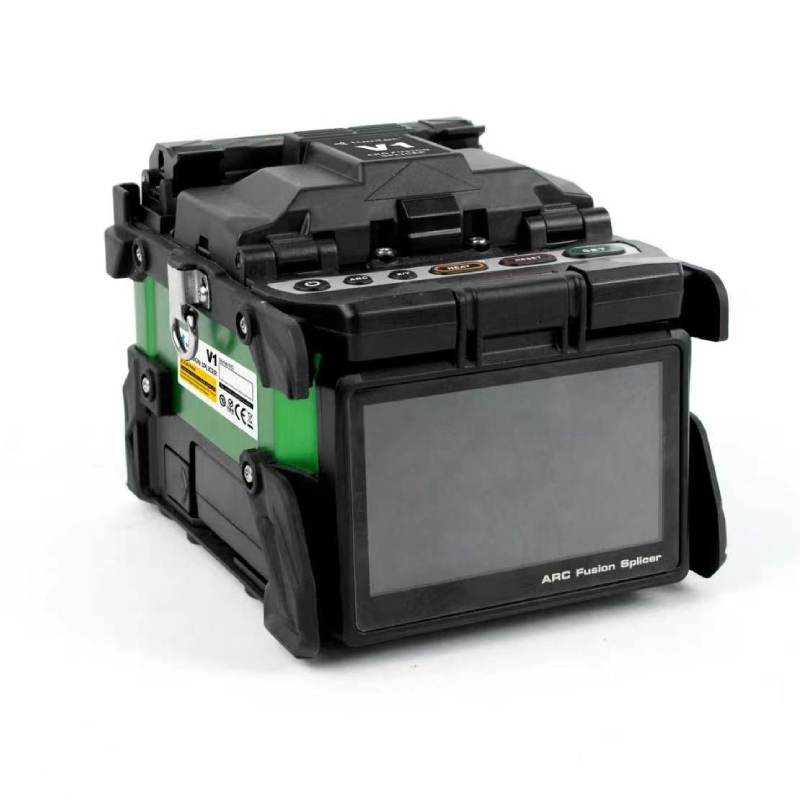
Trunk-line splicing is production work. The spans are long, the splice count per day is high, and every joint is expected to hold its loss figure when the link is tested at handover. A splicer for this work has to do three things at once: align on the fiber core so the loss stays low, cycle fast enough that the crew is never waiting on the machine, and keep doing both from the first splice of the morning to the last one of the day, outdoors, on battery.
The K-V1 is the core-alignment fusion splicer in the fusion splicers and connection range built for exactly that job. This guide walks through what it does and why: the alignment system, the splice and heating pace, the self-calibrating arc, and the records it keeps. The full specification is on the K-V1 fusion splicer product page.
Core alignment, because trunk spans are audited
An alignment system decides what the machine lines up before it fires the arc. A cladding-alignment splicer registers the fibers by their outer glass surface; a core-alignment splicer images the cores themselves and moves the fibers until the cores — the part the light actually travels in — are concentric. The difference shows up in the loss figure, splice after splice. The mechanics are covered in core alignment vs cladding alignment; the short version is that on long spans, where the loss budget is divided across every joint in the route, core alignment is the system that protects it.
On the K-V1, typical splice loss is 0.02 dB on single-mode fiber and 0.01 dB on multimode, with 0.04 dB on dispersion-shifted and non-zero dispersion-shifted fiber and 0.02 dB on bend-insensitive fiber (ITU-T figures), and return loss of 60 dB or better. It splices single fiber — SM, MM, DS, NZDS and BI types — across coating diameters of 0.125–1 mm, with cleave lengths of 5–16 mm and splice protection sleeves from 20 to 60 mm.
The pace of a trunk-line day
A trunk crew's output is set by the slowest step in the splice cycle, so the K-V1 is timed for the whole cycle, not just the arc:
- Splice time 6–10 seconds, with the loss estimated and shown for every joint.
- Heating in 15–30 seconds typical, with multiple heating modes for the sleeve work.
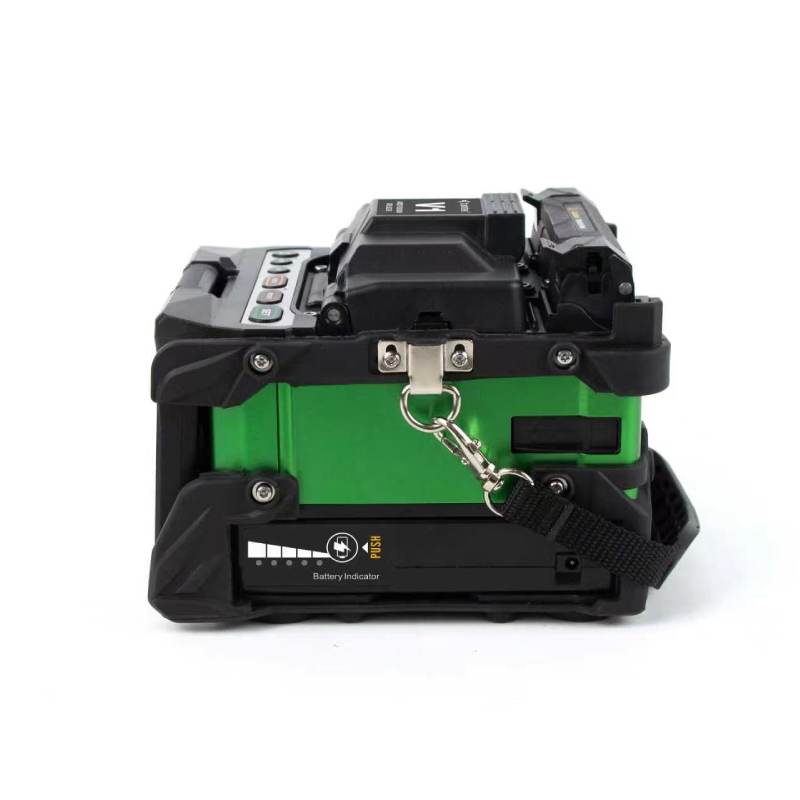
- More than 250 splice-and-heating cycles per charge from the 5,200 mAh lithium battery — a full day's trunk work without looking for a socket. Mains power (AC 100–240 V, or DC 12–15 V) is there when the van is.
- 41 preset splice modes on board, with room to store up to 100, so the mode for the fiber in the closure is a selection, not a setup.
The machine itself weighs 1.36 kg including its rubber bumpers (the battery accounts for 0.38 kg of that), in a 140 × 165 × 126.5 mm body — light enough to work on a platform or in a cabinet without the splicer becoming the awkward part of the job.
An arc that calibrates itself
Arc output that is right at sea level on a mild morning is not automatically right at altitude in the cold — air pressure and temperature change how the discharge behaves, and a fixed calibration drifts with the weather. The K-V1 adjusts for it itself: its adaptive discharge calibrates the arc automatically against air pressure and temperature, so splice number two hundred is made under the same conditions as splice number one.
That self-adjustment is matched by the working envelope: altitudes from 0 to 5,000 m, temperatures from −10 to +50 °C, humidity up to 95%, and wind up to 15 m/s. Trunk routes do not wait for good weather, and the splicer is specified for the conditions the route actually serves.
Seeing the fiber: dual cameras and a 4.3-inch touchscreen
Core alignment only works if the machine can see the cores clearly. The K-V1 images the fiber with dual cameras at 90° and magnifies up to 380×, with X, Y and combined X-Y views — an end-face problem, a dirty cleave or a fiber sitting wrong in the V-groove is visible before the arc fires, not after the loss reading.
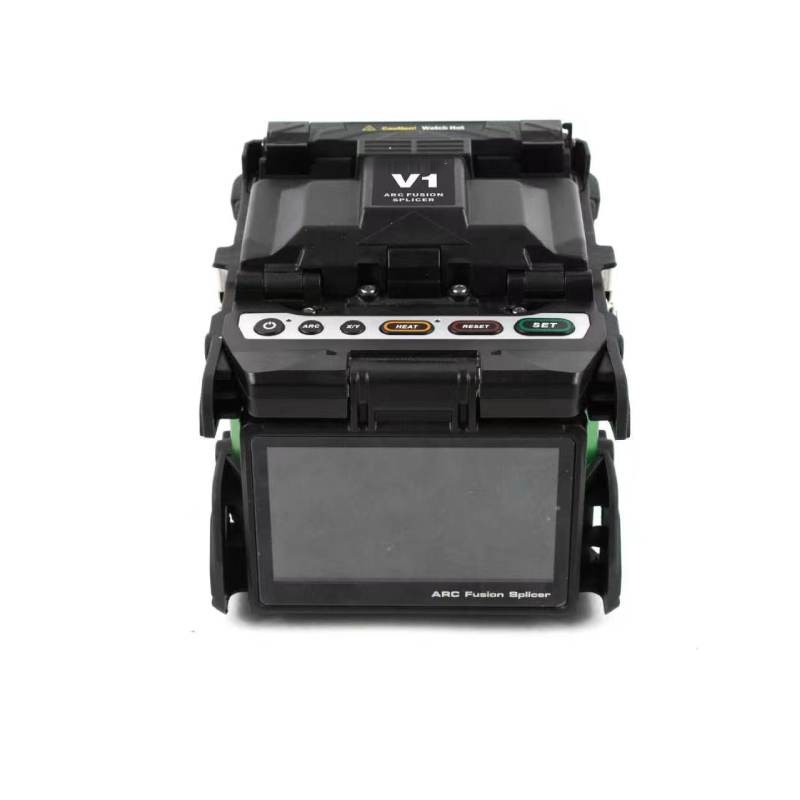
The display is a 4.3-inch colour touchscreen (480 × 272), and the machine can be run from the screen or from its physical buttons — gloves and touchscreens are a poor mix, and the buttons are the answer on cold work. Two high-power white LED lights illuminate the splice area, and the buttons themselves are backlit in blue, so night and cabinet work does not need a head torch pointed into the machine.
Records that survive the handover
Trunk work is handed over on evidence. The K-V1 estimates the loss of every splice as it is made — the first check that a joint is good — and stores the last 10,000 splice records together with 10,000 splice images, so the day's work can be reviewed joint by joint rather than reconstructed from memory. A built-in tension test (1.96–2.25 N) proof-checks the finished splice before the sleeve goes on, and the records move off the machine over a Mini USB 2.0 interface.
Electrodes: plan the wear part
Electrodes are the consumable inside every splicer: the arc erodes them a little with every discharge, and tired electrodes mean unstable arcs and creeping loss. The K-V1's electrodes are rated for 5,000 discharges, which sets the maintenance rhythm — count the splices, and change the electrodes on schedule instead of when the loss figures start complaining. Replacement electrodes and the rest of the splicing consumables sit in the same fusion splicers and connection range, so the spares order goes with the machine order.
K-V1 specifications
| Item | Specification |
|---|---|
| Model | K-V1 fusion splicer |
| Alignment | Core alignment |
| Application | Trunk line projects |
| Fiber types | SM / MM / DS / NZDS / BI, single fiber |
| Typical splice loss | SM 0.02 dB · MM 0.01 dB · DS 0.04 dB · NZDS 0.04 dB · BI 0.02 dB |
| Return loss | ≥ 60 dB |
| Splice time | 6–10 s |
| Heating time | 15–30 s typical, multiple modes |
| Display | 4.3-inch colour touchscreen, 480 × 272 |
| Fiber view | Dual cameras (90°), X / Y / X-Y views, up to 380× |
| Battery | 5,200 mAh lithium — over 250 splice + heating cycles per charge |
| Electrode life | 5,000 discharges |
| Splice modes | 41 preset, up to 100 stored |
| Storage | 10,000 splice records and 10,000 splice images |
| Dimensions | 140 × 165 × 126.5 mm (with rubber bumpers) |
| Weight | 1.36 kg (main unit, with rubber bumpers) |
The short version
For trunk-line work the questions are always the same: does it align on the core, how fast is the full cycle, and will it still be splicing at the end of the day? The K-V1 answers with core alignment at 0.02 dB typical single-mode loss, a 6–10 second splice with 15–30 second heating, an arc that recalibrates itself as the weather changes, and a battery rated past 250 cycles a charge.
Tell us about the routes your crews splice — fiber types, splices per day, the conditions they work in — via the contact form on this site, by email at [email protected] or on WhatsApp at +86 150 6823 2998, and we will confirm the K-V1 fits the work. It heads the fusion splicers and connection range, alongside the SD-6A fusion splicer and the SD-9 fusion splicer, so the splicer, the electrodes and the sleeves all come from the same shelf.