
K-V30 Visual Fault Locator: The Pen VFL in Five Powers
November 9, 2026
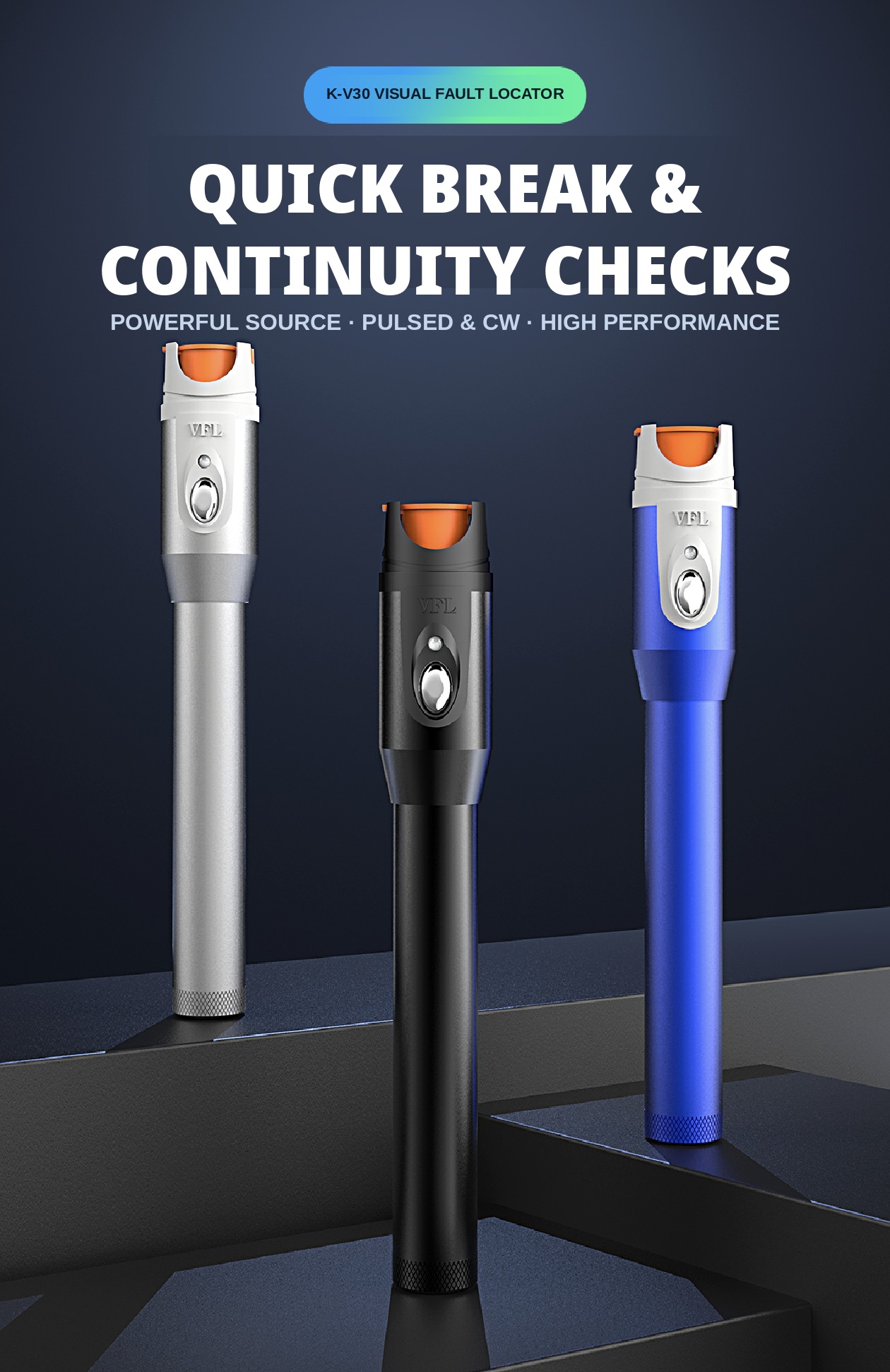
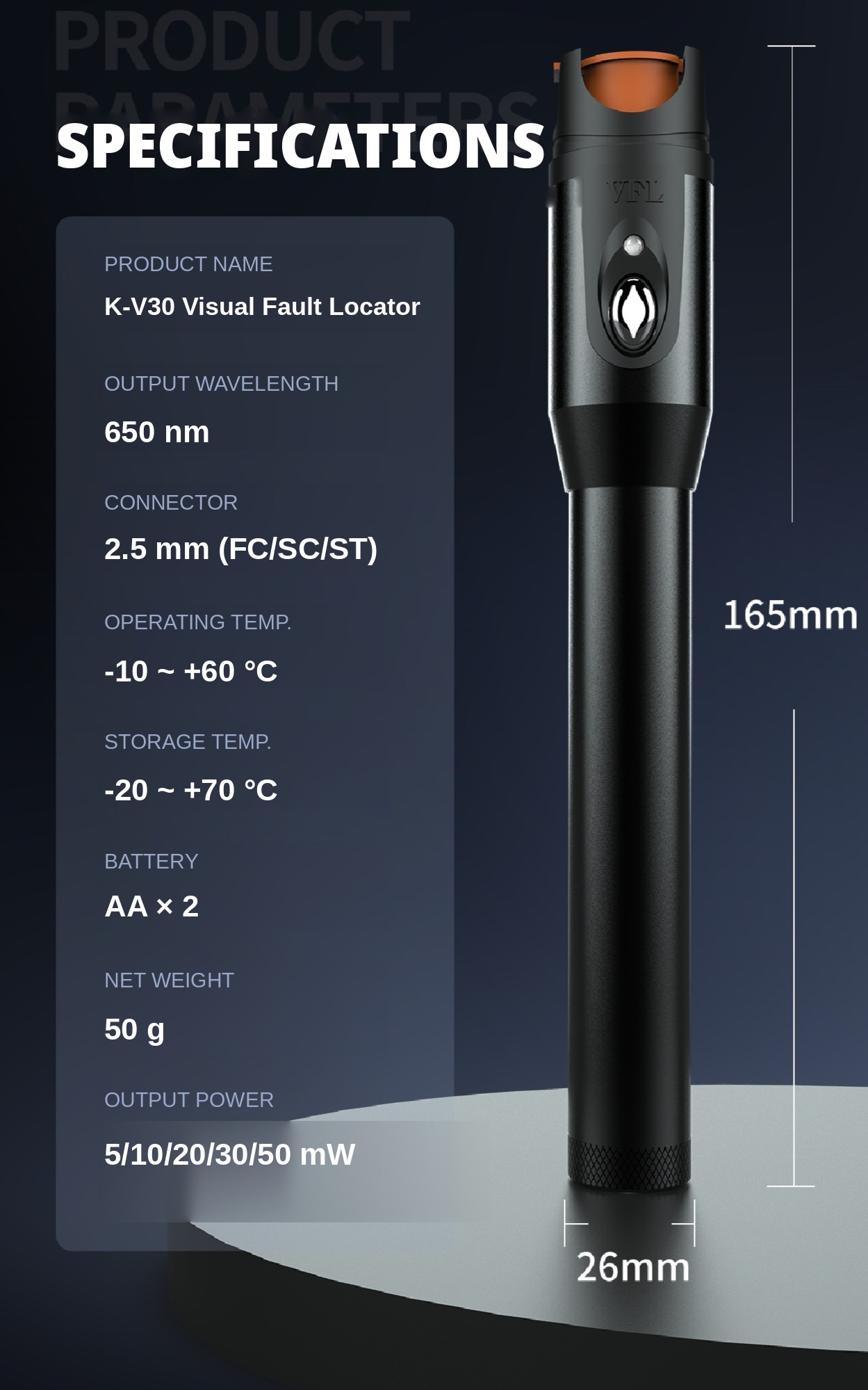
A visual fault locator is the quickest check on a fiber job: connect the pen, switch on the red light, and the fiber itself tells you what is wrong — a break glows, a tight bend leaks light, and the far end of the right patch lead lights up so you know you are holding the correct fiber. The K-V30 is that tool in pen form: a 650 nm red-light pen with an aluminum body, a 2.5 mm universal connector and one button, built in five output powers from 5 to 50 mW so the pen can be matched to the work when it is ordered.
This guide explains what the K-V30 does, how to choose between the five powers, how the one-button CW and blink modes are used, which connectors it takes, and the two wear parts you can replace yourself. The full specification and box contents are at the end. It sits in the fiber test equipment range alongside the other fault locators it is compared with below.
What a visual fault locator shows you
A VFL launches visible red light into the fiber. Where the fiber is intact, the light stays inside; where it is not, the light escapes and is easy to see:
- Breaks glow. At a break or a bad mechanical joint, red light spills out and marks the spot — no interpretation needed.
- Tight bends leak. A bend that is too tight for the fiber shows as a glowing section, which separates a routing problem from a splice problem.
- Fibers identify themselves. Put the pen on one end of a patch lead and the far end glows, so the right lead in a crowded cabinet can be confirmed in seconds.
- Continuity is proven. Light arriving at the far end shows the path is continuous end to end.
What a VFL does not do is measure: it gives no distance to the fault and no loss figure. Locating a fault along a long span is OTDR work — see how to choose an OTDR — and proving loss is a power meter's job. The VFL's place is the fast, visual first check, and on short links — patch leads, drops, in-building runs, cabinet jumpers — it is often the only check needed.
Five powers: pick the output for the work
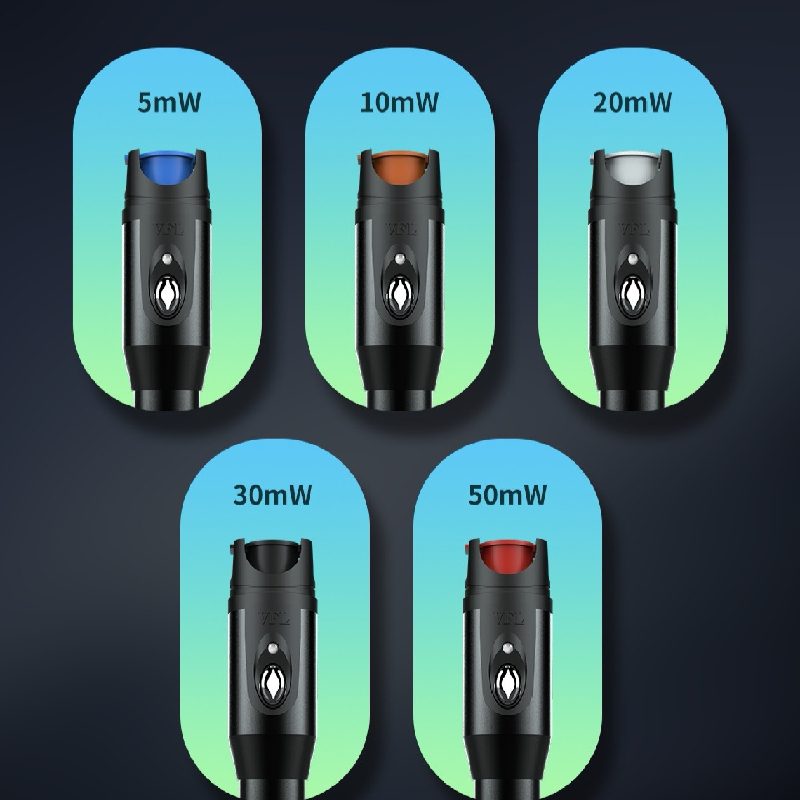
The K-V30 is built in five versions — 5, 10, 20, 30 and 50 mW — and the power is fixed in the pen, so it is chosen when you order. The difference is how bright the escaping light is at a fault, and therefore how easy it is to see under working conditions:
- 5 mW is the patch-lead and cabinet pen: short links, close work, faults within arm's reach. On short jumpers it is all the light the job needs.
- 10 and 20 mW are the everyday field versions — FTTH drops, in-building runs and maintenance rounds where the fault may be a few rooms or a few floors away from the connection point.
- 30 and 50 mW put the most light into the fiber, for longer runs and for working in bright ambient light — a sunlit street cabinet or a lit equipment room — where a weaker glow is hard to pick out.
The practical rule: choose for the longest, brightest job the pen will regularly face, not the average one. A pen bought for cabinet work that later goes out on long drop runs will leave crews squinting; a pen bought for the long runs covers the cabinet work too.
One button: CW and blink
There is one button and nothing to set up. The sequence is the same on every version:
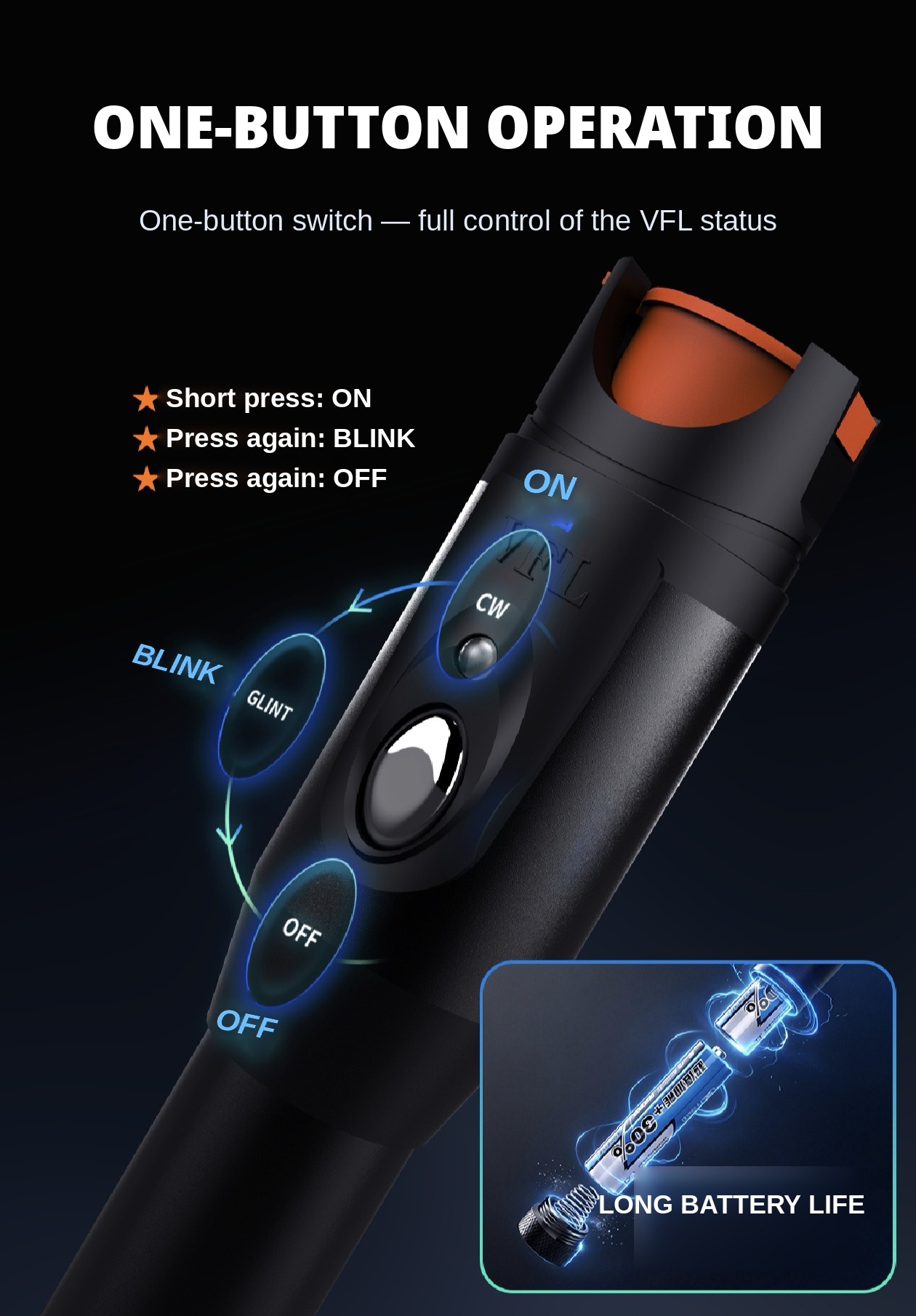
- Short press — the light comes on in CW (continuous wave) mode: a steady beam for continuity checks and for watching a fault glow.
- Short press again — blink mode: the light pulses, which makes a glowing fault easier to pick out among many fibers and other light sources.
- Short press again — off.
That is the whole control set, deliberately: with gloves on, in a dark cabinet, the pen is operated by feel. One safety rule applies to every VFL, this one included: never look directly into the beam. Keep the dust cap closed whenever the pen is not connected to a fiber.
One connector for FC, SC and ST
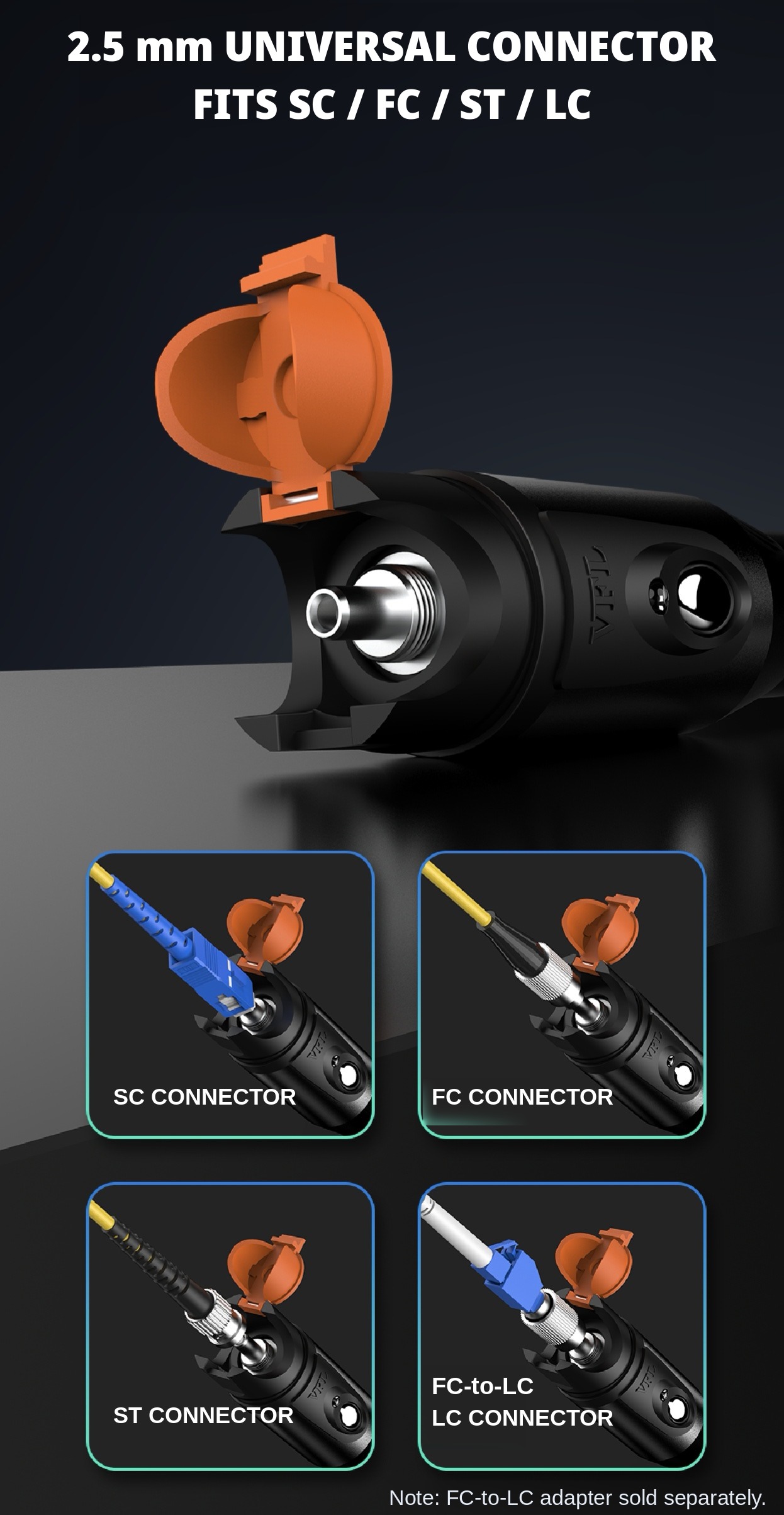
The pen's connector is the standard 2.5 mm universal fitting, so the ferrules a crew already carries plug straight in:
- FC, SC and ST connectors fit directly — no adapter to lose.
- LC connectors need an FC-to-LC adapter, which is sold separately; if your panels are LC, order the adapter with the pens so it is in the bag from day one.
An aluminum pen, not a plastic one
The body is aluminum alloy — non-slip in the hand, corrosion-resistant, and it takes the knocks of a tool bag better than a plastic shell. The pen is 165 × 26 mm and 50 g, so it rides in a shirt pocket or the test slot of a kit without being noticed. Bodies come in silver, black and blue, and the dust caps come in a range of colors with custom colors supported — useful when different crews, powers or customers each get their own color. The button is tested for 100,000 presses, and every pen is break-tested after assembly before it is packed: the pen you receive has already found a fault on the test bench.
The parts that wear, and how to live with them
Two parts of a pen VFL take the wear: the metal head (2.5 mm) that the connector seats against, and the ceramic ferrule (7 mm) that aligns the fiber. On the K-V30 both are replaceable by the user — unscrew the worn part, fit the new one, and the pen is back in service instead of in a drawer. The ferrule is a wear part and is not covered by warranty, so a spare ferrule in the kit bag is cheap insurance for a tool that gets connected and disconnected all day. Keep the ferrule clean — a dirty end face scatters the light before it ever reaches the fiber — and follow the same routine as for any connector: see wet-to-dry fiber end-face cleaning.
Specifications
| Item | K-V30 |
|---|---|
| Type | Pen-style visual fault locator |
| Output wavelength | 650 nm |
| Output power | 5 / 10 / 20 / 30 / 50 mW (version chosen when ordering) |
| Modes | CW (continuous) and blink, one-button operation |
| Connector | 2.5 mm universal — FC / SC / ST direct; LC via FC-to-LC adapter (sold separately) |
| Body | Aluminum alloy; silver, black or blue; dust caps in multiple colors, custom colors supported |
| Replaceable parts | Metal head 2.5 mm; ceramic ferrule 7 mm (wear part, not covered by warranty) |
| Power supply | 2 × AA batteries |
| Dimensions | 165 × 26 mm |
| Net weight | 50 g |
| Operating temperature | −10 to +60 °C |
| Storage temperature | −20 to +70 °C |
In the box
- K-V30 visual fault locator pen, in the power version ordered
- Cloth pouch
- Wrist strap
- AA batteries
K-V30, K-V10 or K-V20?
Three pen VFLs sit in this range, and the difference is in the format, not the idea. The K-V10 visual fault locator is the slide-switch pen in six lower-power versions from 1 to 30 mW — the simple, light-duty option. The K-V20 visual fault locator is the compact pen (145 × 31 × 22 mm, 100 g) in 10 to 50 mW versions, running on AAA cells or a rechargeable lithium battery with USB-C charging. The K-V30 is the metal-bodied one: aluminum shell, standard AA batteries, a 5 mW version for close work alongside the higher powers, and a head and ferrule the user can replace. If the fault locator also has to measure, the K-PV1 power meter + VFL combines a −70 to +10 dBm power meter with a 10 mW VFL in one unit instead.
Selection checklist
- [ ] Longest and brightest job the pen will face identified — power chosen for that, not the average job
- [ ] Connector types confirmed: FC / SC / ST direct, LC needs the FC-to-LC adapter ordered with the pens
- [ ] Body and dust-cap colors picked (custom cap colors if crews or customers are color-coded)
- [ ] Spare ceramic ferrules added — the ferrule is a wear part and is not covered by warranty
- [ ] Cleaning covered: a dirty ferrule wastes the light before it reaches the fiber
- [ ] Meter and OTDR coverage decided — the VFL shows the fault; it does not measure distance or loss
The short version
The K-V30 is a 650 nm pen VFL in an aluminum body, in five powers from 5 to 50 mW chosen when you order. One button runs CW and blink modes, the 2.5 mm universal connector takes FC, SC and ST directly (LC via an adapter, sold separately), and the head and ceramic ferrule can be replaced by the user when they wear. Pick the power for the longest, brightest job, keep a spare ferrule in the bag, and never look directly into the beam.
Tell us the work — link lengths, connector types and how many pens per crew — via the contact form on this site or on WhatsApp at +86 150 6823 2998, and we will confirm the power version and the adapters for your panels from the fiber test equipment range. Dust-cap colors can be matched to your crews or your brand; ask when you write.